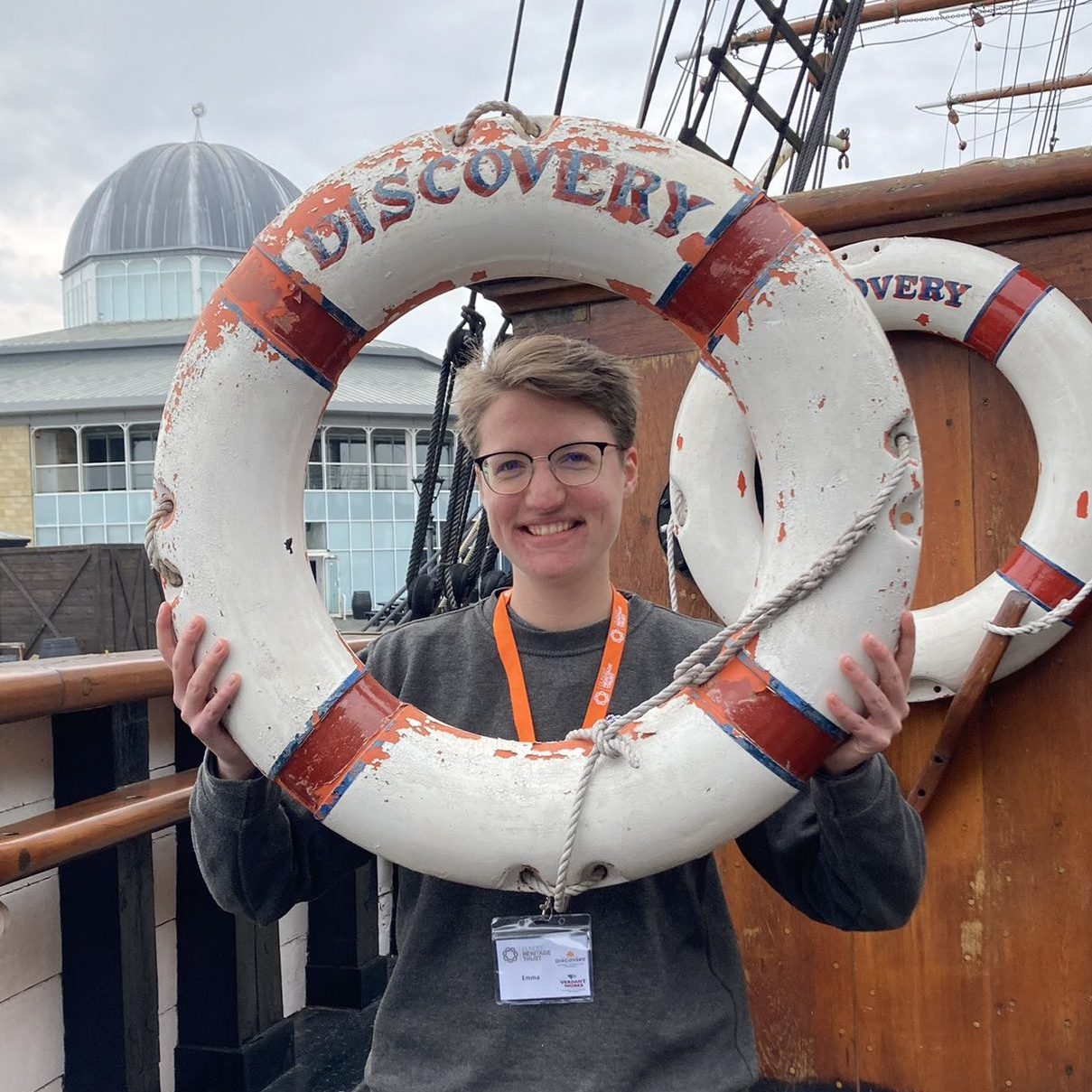

“So, how much is original?”
This is one of the most common questions I get asked while working on Discovery. (Although sometimes, visitors come onboard with the impression the ship is a replica. In that circumstance I find myself with the immense pleasure of informing them it’s real, and watching their eyes light up in wonder!)
“Well,” I typically respond, “have you heard of the Ship of Theseus?”
The Ship of Theseus is a thought experiment, first posited by Ancient Greek philosophers. In it, you take a ship—say, Theseus’s ship of Greek myth, or, in our case, the Discovery. Slowly, as the years go by and repair after repair is undertaken, the entire ship is replaced such that no original material remains. This happens beam by beam, seam by seam.
Is that ship the same ship?
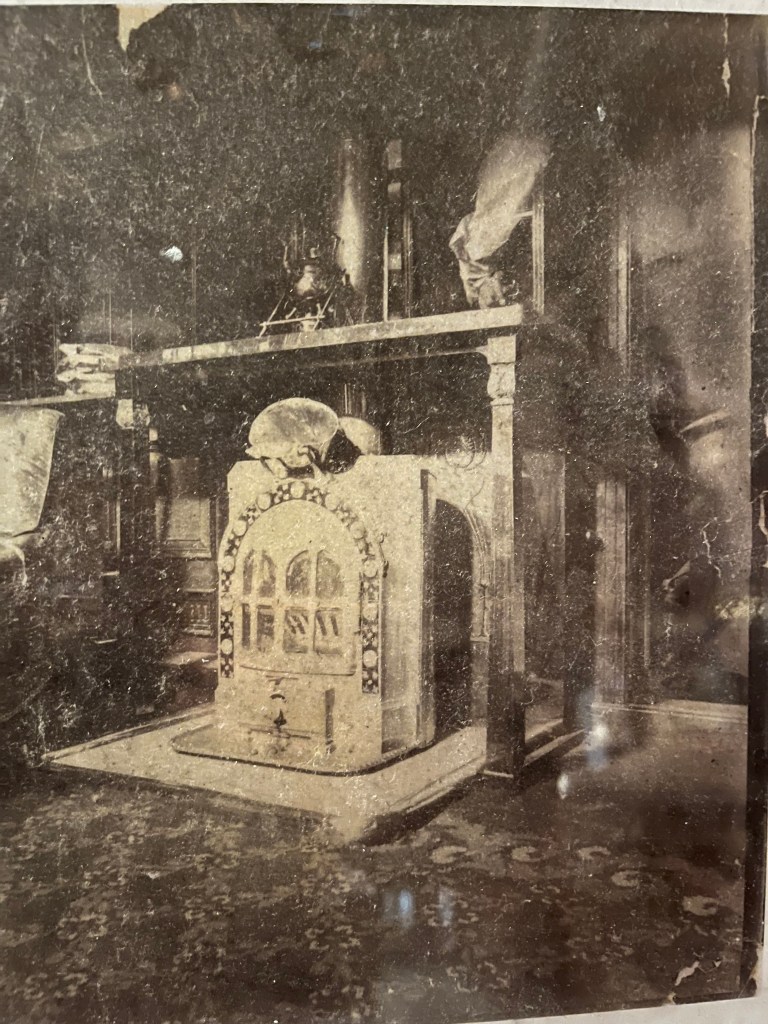
Now, by that definition, Discovery is categorically not a Ship of Theseus. There are original parts. The hull still contains original timbers that withstood the crushing ice of the Antarctic for two winters frozen-in. The Salamandre stove in the wardroom is original from the 1901-1904 expedition and warmed the officers through those harsh winters. But these are precious few and far between. Everything else—the masts, the deck, the binnacles, the cuddies, each belaying pin and scrap of oakum—have been replaced at least once, and often multiple times. When the Hudson Bay Company bought Discovery after she returned to England in 1904, they gutted the interior to create more cargo space, and there went the wardroom and the custom-built scientific equipment. During the extensive Vosper refit in 1924, which prepared Discovery to once again venture south for the Oceanographic Expedition and later for BANZARE, the hull was re-planked, and the science labs and wardroom were rebuilt in a different configuration1. Largely, this is the configuration that survives today. While a few original pieces remain, Discovery is changed in arrangement and composition. But the question still applies.

A working ship is constantly being remade, hence the Ship of Theseus issue in the first place. But Discovery is no longer a working ship—she is a formerly seafaring vessel that transited the world and has come back to retire in the city where her keel was first laid. She’s been a training ship for Sea Scouts, a medical testing site for the Navy, and, today, she is a museum that welcomes hundreds of visitors every day. You can stand at her stern and face the wide silvery ribbon of the Tay, but she will sail upon that river no more—much less could she anticipate a return to the Antarctic.
Applying the Ship of Theseus to a historical ship—a museum ship—adds a twist to the thought experiment: at some point, repairs transition to conservation. People want to see Discovery because of the idea that this is the same ship. It’s a crucial facet of the attraction. For the museum ship, originality and integrity become much more important than for any given working vessel, where function trumps authenticity. This has practical ramifications: I and my fellow ship’s crew are not, today, updating Discovery‘s technology. We’re not redesigning or improving her sailing efficiency. Such decisions must be made in conservation work. There’s a reason we still caulk the traditional way, with mallet and irons, oakum and pitch: we’re trying to preserve her as she is. To keep her watertight so she won’t decay. Despite the fact that she has changed so very much.

So, given she is nearly entirely changed, given her museum status makes her identity that much more important, the question presses: is Discovery the same ship?
My answer to this conundrum is plain and simple: yes. Yes, she is the same ship.
Why? Not because she has 4.7 original panting beams (number made up for effect), nor because there’s a stove that Shackleton touched. The object itself does not matter. What?! I hear you cry, but you’ve just spent paragraphs telling us it does! And yes, I do see the irony. I feel the irony, too, as I’m currently typing this with back and arm muscles sore from labouring to preserve the object in question. Why would I do such a thing if the object didn’t matter?
It’s because I am not labouring for the object—I’m labouring for what it means. It’s ever so easy to get lost in the physical, material, logistical parts of the Ship of Theseus question. But to me, they are not, nor have they ever been, the point. The actual physical vessel is just a bunch of wood and metal (I’m sorry, old girl, but you are! And I’m just a bunch of meat.).
It is Discovery‘s story—the meaning I and so many others, past and present, have imbued within it—that is what matters. Discovery is the same ship it’s always been because it has the same story. It’s got good and bad in it, and it’s part of the human story, and I think it’s worth telling. It’s a story of scraping the edge of the unknown, of risking everything, of being a home and a workplace and a site of tragedy and joy and everything in between. This story has been told and retold and lived and relived by an unbroken chain of shipwrights, explorers, traders, Sea Scouts, tourists, curators, and historians. Shackleton typed it in the South Polar Times office in the hold. Scott told it in Voyage of the Discovery. So did Mawson, and Ann Savours Shirley, and the Dundee Heritage Trust, and every volunteer who has ever stood on her decks, and every visitor who has seen and read and remembered. That chain includes me. Perhaps it includes you, too.
It’s a simple answer. I hope it doesn’t feel like a cop-out. Museum objects are always about the meaning2.
The 1901-04 expedition members themselves never imagined Discovery‘s future would be as it is today—a museum and celebrated heritage site. I know this because they said so themselves. Reginald Ford, a steward with a keen interest in history, wrote an article in the South Polar Times (using the pen name “Historicus”) in which he laid out the history of the name “Discovery” for exploring ships. He even muses about how Baffin, commander of a 17th-century Discovery, might feel were he somehow transported to the deck of the 1901 Discovery (in a moment of historical connection, I will admit to having performed similar daydreams/thought experiments). He concludes his article by musing about the 1901 Discovery‘s future:
Had we the necromancer’s crystal ball we might look into the future and see her in the sunset of her days engaged in some useful work as a store ship or coal hulk. This is all we dare hope for her, but without a doubt her name will be carried on though many years until the remote period where no more discovery remains to be done.
“Historicus” also known as Reginald Ford, South Polar Times Volume II
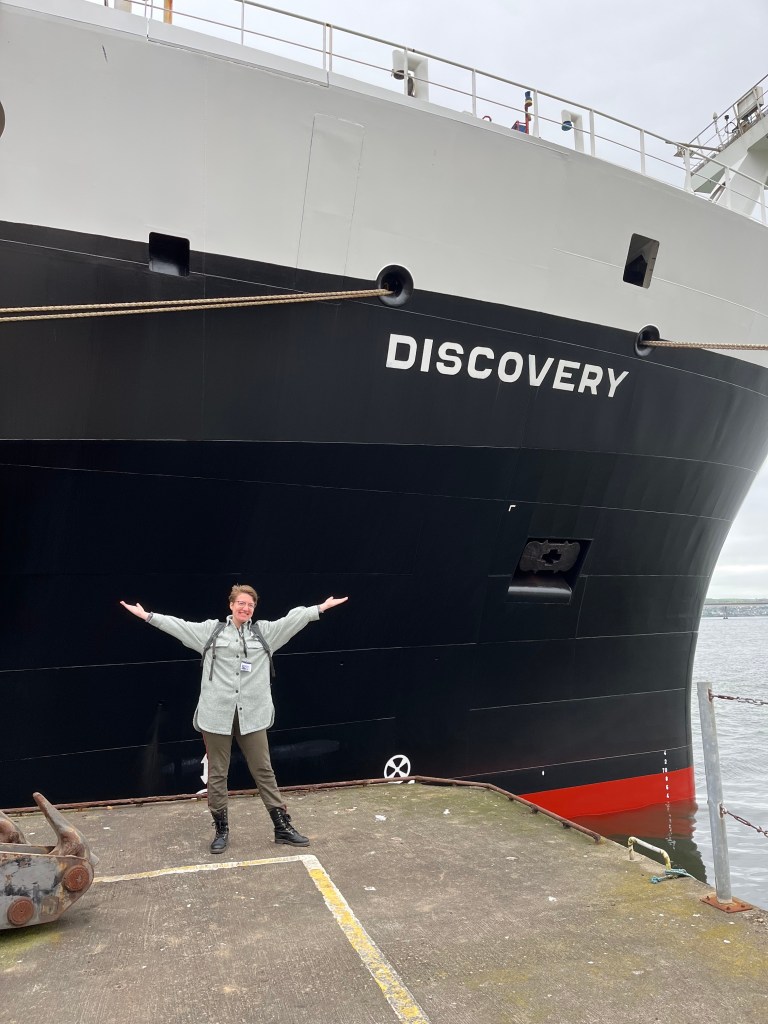
I am pleased to inform Reginald Ford’s ghost that not only is Discovery still around and kicking, but there have been more ships under the same name. There’s a line of scientific research vessels with the name RRS Discovery, the most recent of which was launched in 2012. I had the privilege of touring her last June, when she came to visit her great-grandma (1901 Discovery) in Dundee. Not gonna lie, I teared up seeing her name on the side in the same font as “my” Discovery.
1901 Discovery is also one of the namesakes of a much more out-there vessel—the space shuttle. Not only has a telescope taken on the 1901-04 expedition also travelled to space aboard the shuttle, but one of the shuttle crews has visited the ship in Dundee. History is rhythms and ribbons and circles, and repeats and deepens its own rhymes in the retellings, for good or ill, in the ways people imbue meaning. I like to think Reginald Ford would have been over the moon to know a Discovery has left the atmosphere, and that many have taken up his mantle and keep telling her story.

The Oh Hellos, a band I quite like, have a song called “Theseus”, and naturally it makes me think of Discovery. It’s lyrics speak to my own answer to the thought experiment:
No single use ark to discard in an instant
–Oh Hellos, “Theseus”
Like Theseus’s ship, we’ll fix the busted bits
‘Til it’s both nothing like and everything
It’s always been
It’s a wonder we expect a thing to
Stay the same at all
A wonder, indeed. The world is different, but the story remains.
 Glossopteris
Leave a comment