
Today, March 27, is Kathleen Scott’s birthday. The woman who married Robert Falcon Scott is more than worthy of study in her own right. Her time married to the explorer was, of course, tragically cut short—but even still, she accomplished so much that her few years with Scott constitute only a fraction of her autobiography Self-Portrait of an Artist. To give just a taste of her whirlwind life: she studied sculpture under Rodin, nearly died of an illness contracted working as a nurse with a relief mission in war-torn Macedonia, influenced multiple prime ministers and was involved in the formation of the League of Nations, reconstructed wounded soldiers’ faces after the First World War, travelled to every continent except Antarctica, and later remarried to the M.P. Edward Hilton Young, all the while raising two sons and winning awards for her art.
Kathleen was nothing if not starkly individual, a free spirit who could have a laser focus and determination. Her political views, too, do not fit neatly into any box nor do they translate well to modern times—she was incredibly independent and self-sufficient, yet staunchly against women’s suffrage. Historian Janice Cavell writes “Neither a conventionally feminine woman nor an early feminist, she has little appeal for any constituency of writers or readers today.”1
Well, I find her wildly fascinating as a historical subject. And needless to say you don’t have to agree with your historical subjects.
But I don’t have time to write a deep dive on Kathleen today2. I’m here for one reason only. I’m here to be short, sweet, and to-the-point. I’m here to correct an injustice.
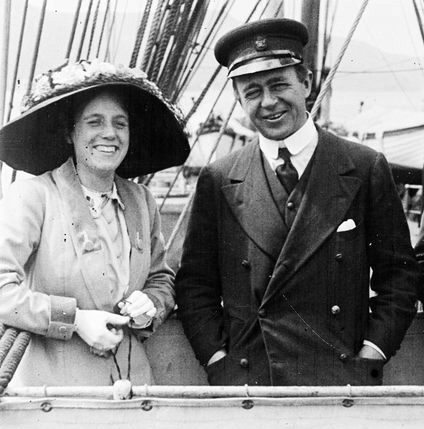
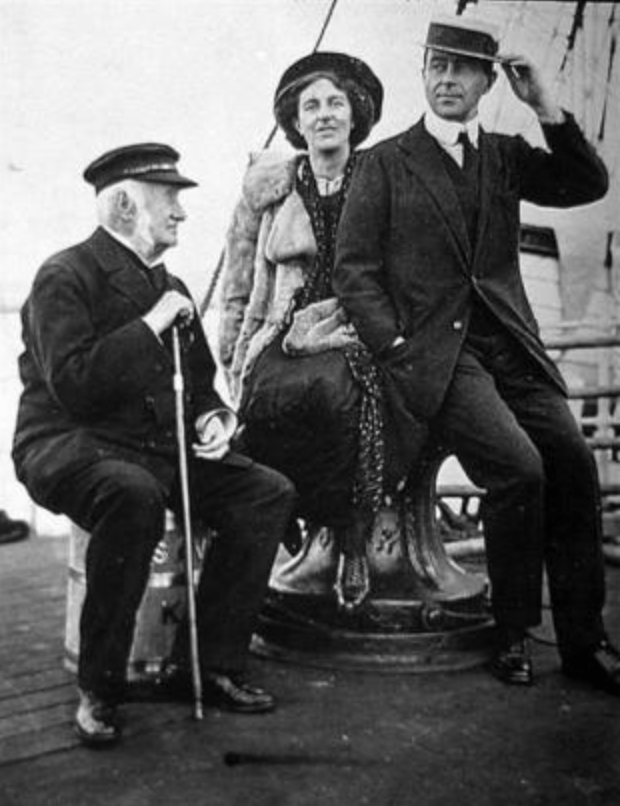
Did you know one of the most famous pictures of Kathleen Scott….isn’t actually her at all? It’s all over Google images, it’s on both Kathleen’s and Scott’s Wikipedia pages—and it’s not of the right woman!
This is the image in question, although it’s usually cropped to remove the man on the right:
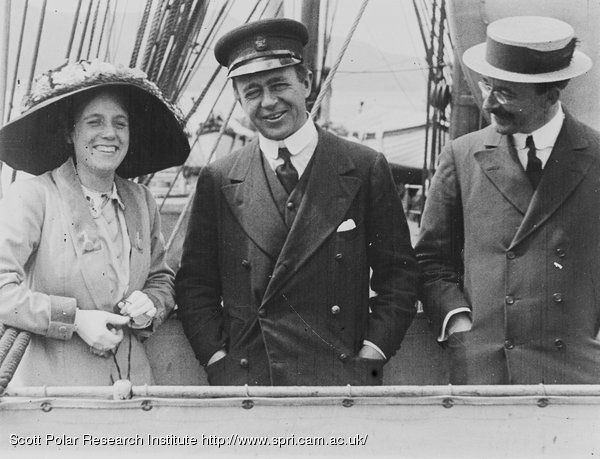
Removing the man on the right—George Wyatt, the Terra Nova expedition’s London agent—leaves what seems a charmingly framed photograph of a happy couple. “Kathleen” and Scott are laughing, they’re leaning slightly in towards each other, they look cheerful, like they’ve just shared a joke—which they may well have done! The only problem is that that isn’t Kathleen Scott laughing on the deck of the Terra Nova.
I think this cheerfulness is the reason this photo has proven so popular. It’s just so photogenic and animated! Especially when so many period photographs appear stiff to our modern gaze3, this presents an image of a happy couple. We know Mr and Mrs Scott were a very happy couple, so this picture fits in well with that knowledge.
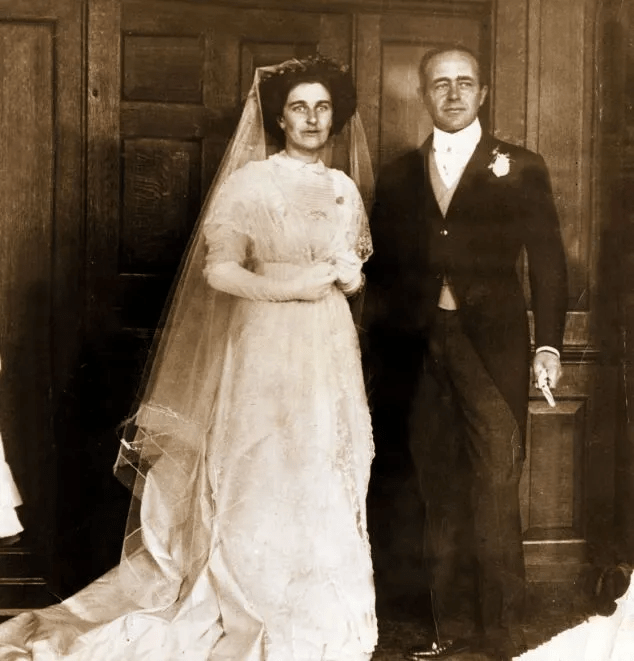
Most of the real pictures of Kathleen with her husband look a lot more…wooden, at least to me. Here they are on their wedding day:
And surveying the ponies on Quail Island, New Zealand:
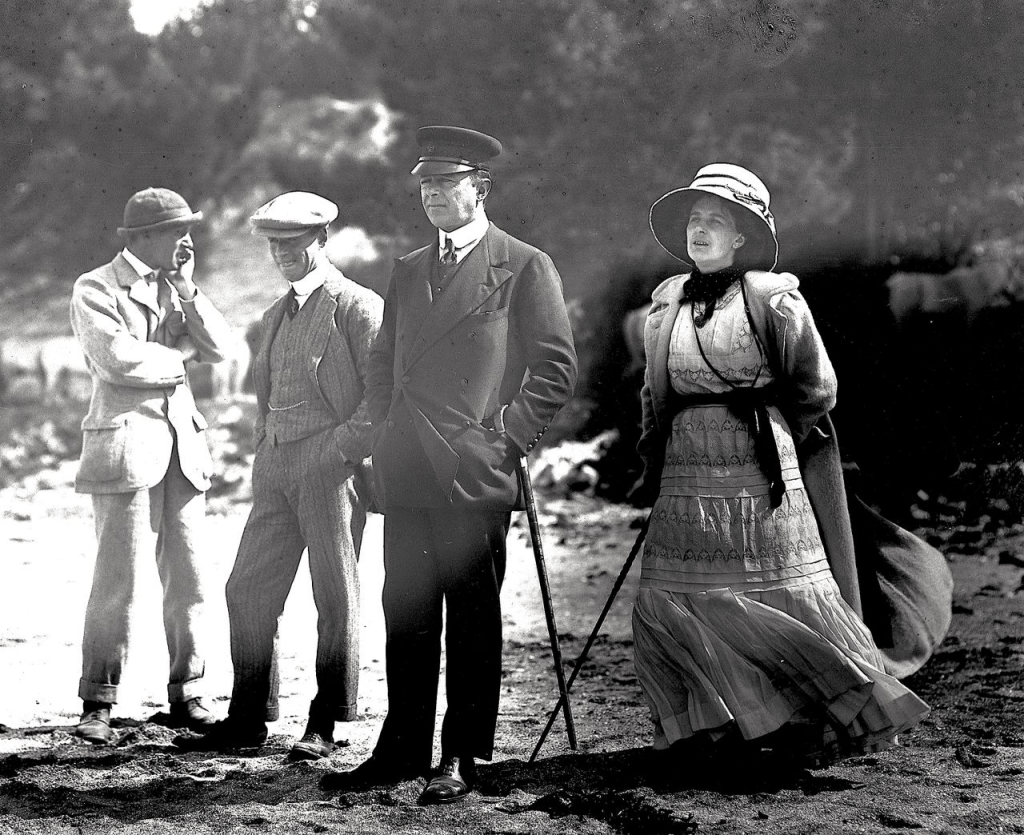
And this one is a bit more jaunty, but still lacking the obvious joie de vivre of the photo with the Mysterious Woman:
I recently saw a talk by Katherine MacInnes, author of Snow Widows, during which she spoke about this persistent image-labelling mix-up. She pointed out half-jokingly that even if one cannot tell the faces apart, the Mysterious Woman is obviously not Kathleen because Kathleen did not care much for fashion—James Lees-Milne described her as having “a sort of aggressive no-taste”—whereas the Mysterious Woman is looking very chic4. More soberingly, MacInnes said, the mislabelling highlights how invisible the women in the lives of Antarctic explorers can be. Even to historians—even today—and even the wife of the expedition leader.
So, what happened? Who is the Mysterious Woman? Well, I haven’t traced the mislabelling through the archival trail—my suspicion is someone initially mislabelled it and it has persisted due to the aforementioned photogenic quality of the image—but I can answer the rest.
The photograph isn’t actually a photograph at all. It’s a still from a motion picture (hence the animated quality of the expressions!). You can see it used in Ponting’s Great White Silence after the title card at 6:46: https://youtu.be/kQujzJDj52k?t=406 (link goes to desired timestamp). In the film, the crop only shows Scott, but you can see the woman’s hat and arm, and the other man’s elbow. It’s the same footage.
Here’s another still from a different part of the uncropped footage. From her profile view, it’s much more obvious that this woman is not Kathleen (and also that her hat game is incredible!)
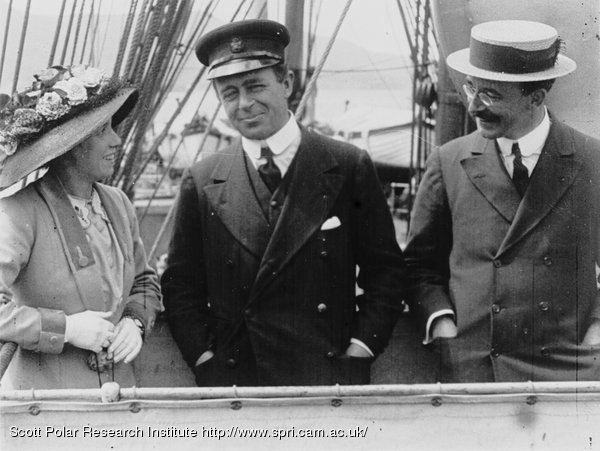
The Mysterious Woman is, in fact, Mrs George Wyatt, the wife of the expedition agent standing on the other side of Scott. I regret that I don’t even know her first name—another example of historical invisibility. The only other thing I can tell you about her is that, according to Pennell’s diary5, she had a wonderful singing voice.
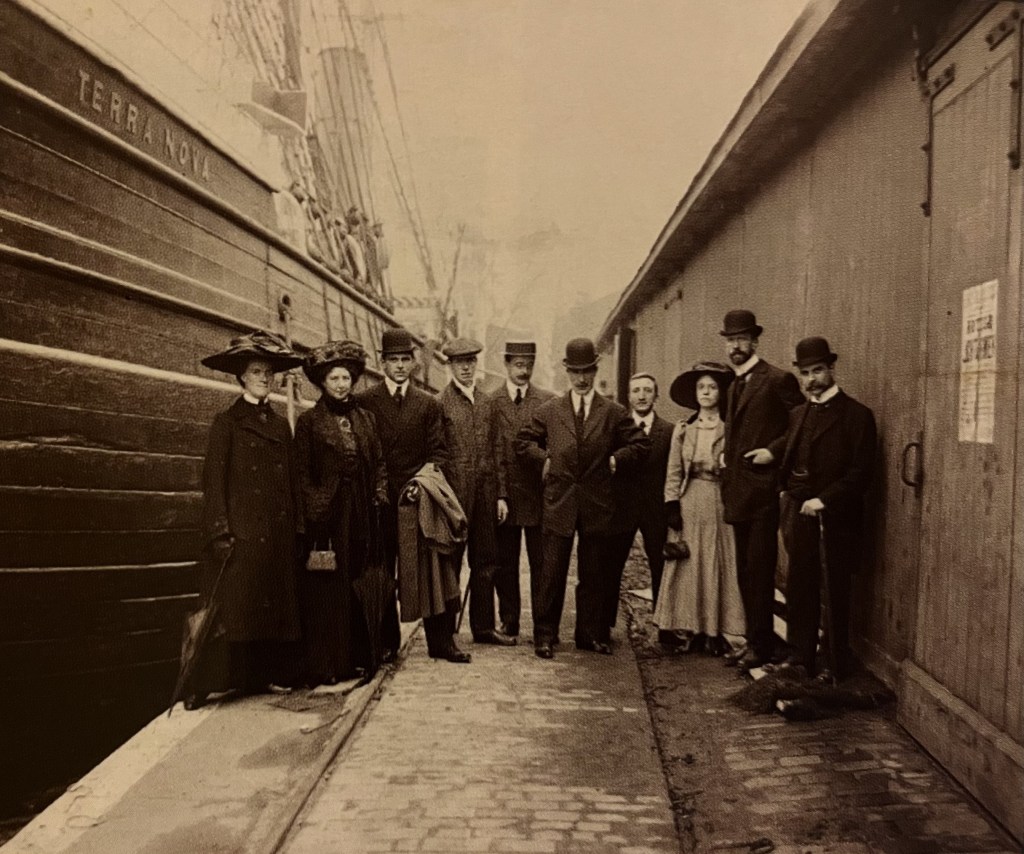
Here is another group photo, in which Mr Wyatt is fifth from the left, and Mrs Wyatt is third from the right. This photo is from London in June 1910, a few months before the video footage was taken.
So, what am I hoping to accomplish with this post? Aside from making a point about how easy it is for one archival mistake to snowball through the drift of citations, and about the invisibility of women in Antarctic history…I just want people to stop labelling the image as Kathleen Scott! I’m not a Wikipedia editor, but if anyone is, or knows someone who is, it would be great to get the image fixed on both Robert Falcon and Kathleen Scott’s pages.
I’ll leave you with a few book recommendations to learn more about Kathleen:
- Self-Portrait of An Artist, from the Diaries and Memoirs of Lady Kennet, Kathleen Scott
- Snow Widows: Scott’s Fatal Antarctic Expedition Through the Eyes of the Women They Left Behind, Katherine MacInnes
- Widows of the Ice: The Women that Scott’s Antarctic Expedition Left Behind, Anne Fletcher
- A Great Task of Happiness: Life of Kathleen Scott, Louisa Young
Happy reading!
UPDATE 28/3: Thanks to some lovely folks, the wiki pages have been edited, and we now know Mrs Wyatt’s given name was Miriam!

- “Manliness in the Life and Posthumous Reputation of Robert Falcon Scott”, Janice Cavell, Canadian Journal of History, Winter 2010 ↩︎
- I just submitted my thesis this afternoon. Why am I writing a blog post? Good question. I don’t know how to take a break. ↩︎
- I often wonder about the history of posing for photography, and think about how people 110 years ago would have so much less practice in front of a camera than we do today ↩︎
- Quoted in Young, “A Great Task of Happiness” ↩︎
- As quoted in Allegra Rosenberg’s blog post ““Antarctic Lovebirds” – the untold story of Harry Pennell & Edward Atkinson” ↩︎


 Glossopteris
Leave a reply to louisa young Cancel reply