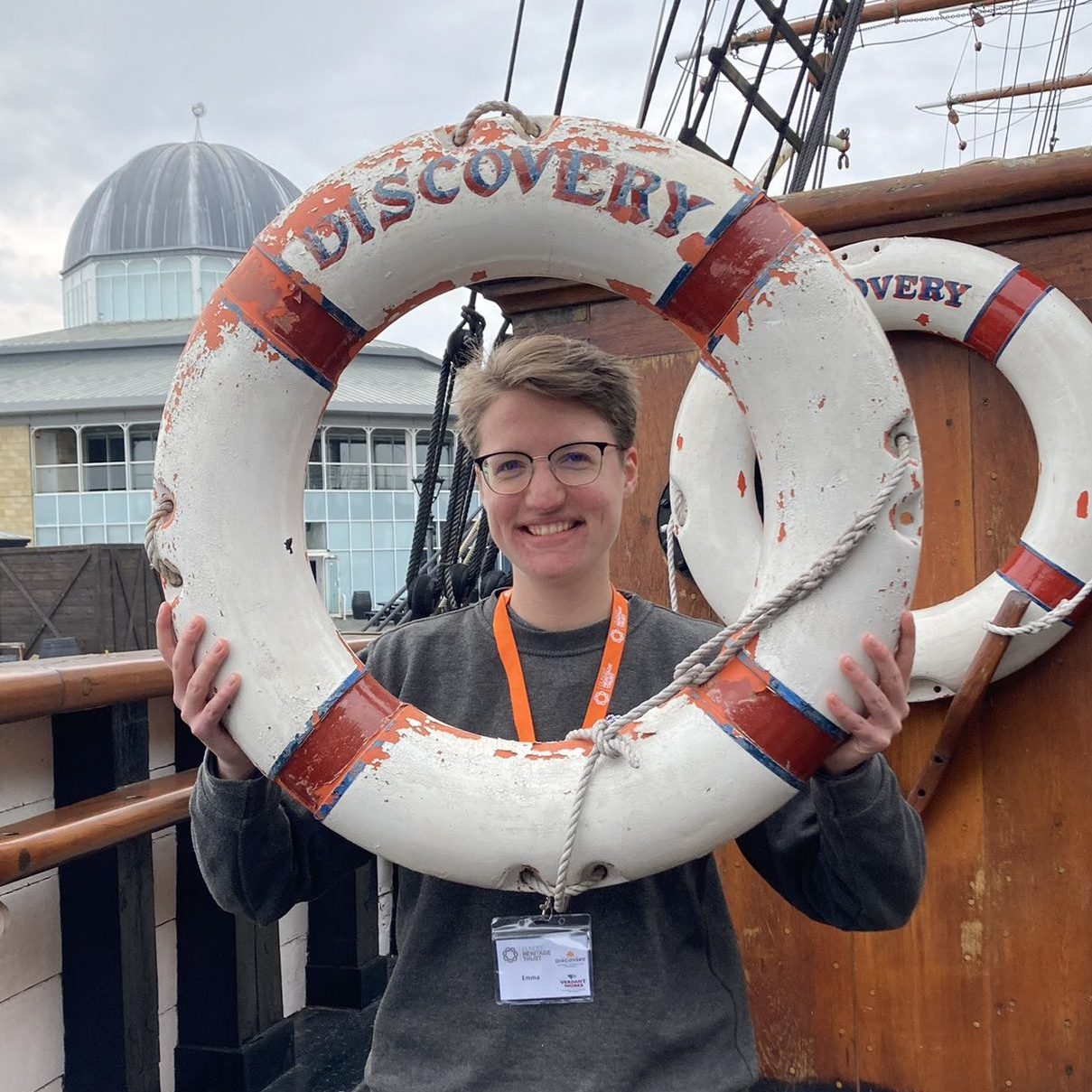

It’s been a bit! I have a few more involved posts in the works, but for now, why not ease back in to Glossopteris with a travelogue?
In June, I travelled to Norway with my dear friend and fellow polar nerd Madeline Newbery. The main purpose of the trip was, naturally, to spend some quality time with Roald Amundsen—and to see the only other surviving Heroic Age Antarctic expedition ship besides Discovery, the Fram1!
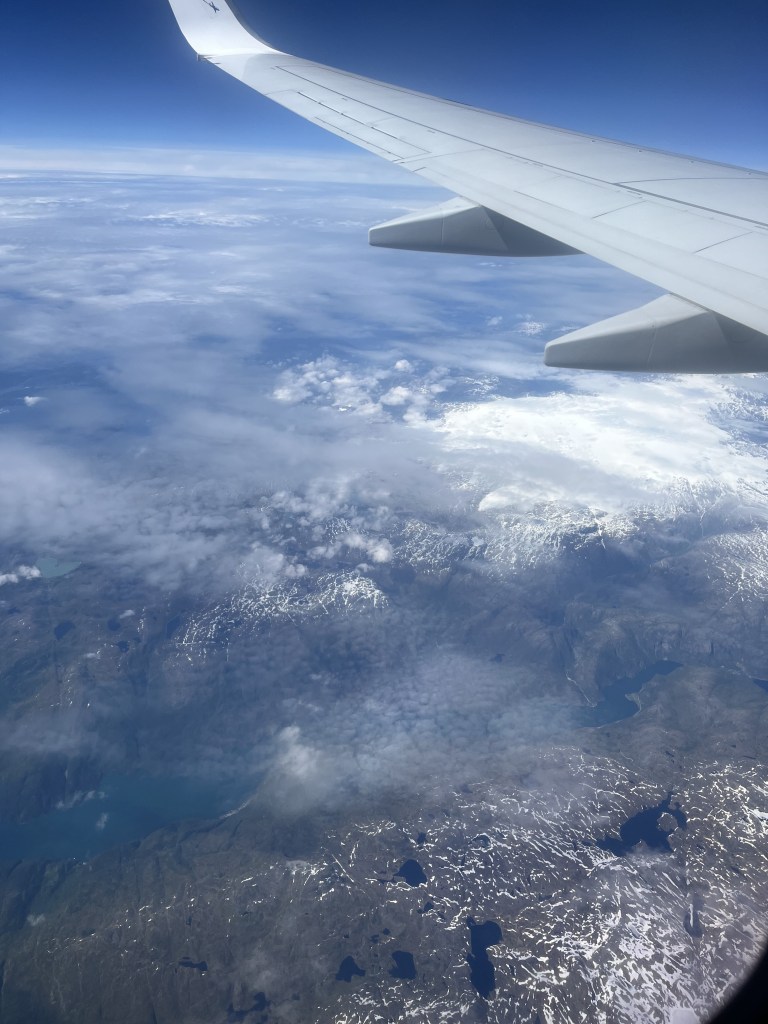
Madeline, whose Amundsen knowledge far surpasses mine, made the perfect combination-travelling-companion-and-tour-guide-despite-never-having-been-to-Oslo. I found myself working my way through Bown’s The Last Viking on the plane in a futile attempt to—well, not to catch up, but at the very least to arrive informed. I’d never been to any part of Norway before. While Oslo is in a (relatively) flat area, our flight path from Edinburgh brought us right over the rugged mountains and fjords of western Norway. Looking out the window, I spotted the Hardangerjøkulen, a glacier on a plateau which a young Amundsen nearly died traversing in wintertime. I was amazed at how much snow and ice there was even at midsummer, after more than a hundred years of global warming—I can only imagine the brutal landscape Roald and his brother Leon faced.
The Oslo area is home to two major sites of interest to the polar afficionado; these are the Fram Museum and Roald Amundsen’s house, Uranienborg2, and both were on our itinerary. But, like any good polar expedition, first we had to establish our base.
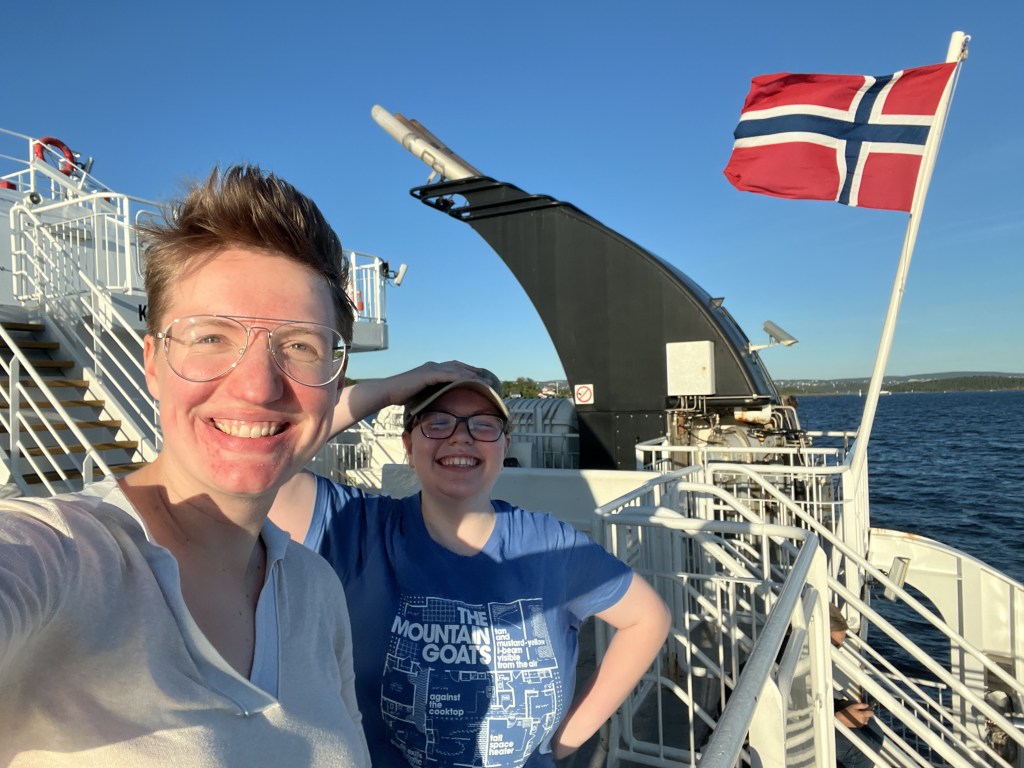
It seemed a bit dull to come to a country renowned for its natural beauty and spend the entire time in a city, even one as cool as Oslo3. Oslo is built around the Oslofjord4, an inlet that curves along the city centre and wraps around a more-sparsely-populated peninsula to the south. It was on that rural peninsula where we stayed. This meant that every day, to get to Oslo, we took the ferry. The ferry was very much a feature, not a bug—daily we became part of the hive of activity that is the Oslofjord, dotted with rocky islands and constantly plied by all manner of watercraft. Wind in my face, gazing out at picturesque brightly-painted houses on granite outcrops, I thought, yes—I could be very happy with this as a regular morning commute5!
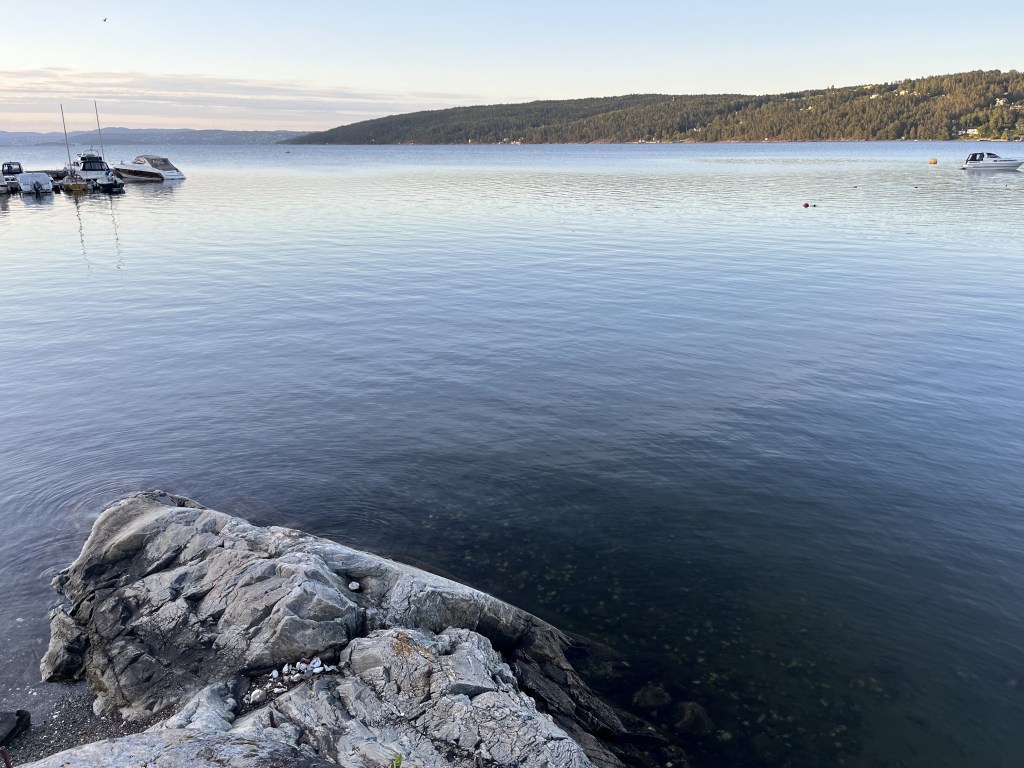
We stayed at a charming airbnb right on the fjord. The house was rustic and built in 1911 (fittingly), and had the bonus of being right across the water from Amundsen’s house. In the mornings I would sit on the rocks with a cup of coffee and stare longingly at Uranienborg.
Actually getting to Amundsen’s house was…a bit harder. Getting to Oslo city centre from our airbnb took about an hour, but Amundsen’s house is well outside the city. Even today, it remains more accessible by water than by land, matching the reclusive personality of its famous inhabitant. Our airbnb hosts had a motorboat, but, neither Madeline nor I being certified, we were unable to rent it. (We could imagine the headline if we attempted it: Tourists crash boat into Amundsen’s house; banned from Norway for life). So instead we took the long way…a bus, a ferry, a bus, and yet another bus for good measure. At one point the third bus driver showed off his skills by expertly ascending switchbacks in his unwieldy vehicle6. After 2.5 hours, we found ourselves at the top of a very steep road that led down to the water…and Uranienborg.

(As an aside, I am very ready to praise the Norwegian public transit system. I paid the equivalent of £45 for a 7-day-pass which covered all the buses, trams, and ferries I needed. Everything was on time and worked. Most places in the world, the kind of trip we did would not be possible without a car! Also? Their trains have coffee/soup vending machines. Check out the Ruter app, if you’re going.)
Roald Amundsen’s house is only open on weekends in the summer, and you must book a guided tour ahead of time. Tours are hourly, and the timetable is strictly adhered to. This is all in service of balancing access with the need to conserve the fragile house—kept, for the most part, exactly as it was in 1928 when Amundsen left to rescue Nobile, and instead disappeared forever into the Arctic.
I say “for the most part” because of course curatorial decisions are made, and remade, and ideas about (and the technology of) conservation changes over time. Items are stolen (including Marie the polar bear, stolen in the 1980s and later returned because the thief was admonished by the person who he tried to sell her to “we don’t steal from Roald Amundsen”), photographs fade as light wreaks havoc, and even taking all precautions, guests bring fingerprints and dirt. As a museum person, I’m almost as interested in the history of Uranienborg’s time as a museum as I am in what made it famous. I chatted with our guide about this, asking her whether the 2019 Amundsen biopic had filmed in Uranienborg—no, she said, they built a replica set because the house was too fragile. The Last Place on Earth, though, I know to have filmed there in the 1980s—though they seem to have made an effort to film outdoors as much as possible; I would surmise this was for conservation concerns.
Upon entering, we were asked to cover our shoes with booties7, and instructed not to touch anything—not even to lean on a wall. Our tour guide was absolutely lovely. She seemed a bit nervous to do an English-language tour—I got the sense most visitors were Norwegian—though of course her English was excellent. She asked us if we had a special interest in polar history, and since we did, she seamlessly adapted the tour to skip the basics and cater to us. As we went to each room, we stood behind a rope while she moved from object to object and told stories.
Amundsen’s house has been fully 3d-modelled and you can explore the whole place online. This is not only a great accessibility and education tool, but it also meant that Madeline and I already knew what we would find in each room—and yet, it remains ever true that to be there is different. There was something haunting about the quiet house, a strange sense of meaning and timelessness which all museum objects become imbued with that was only accentuated by our hushed footsteps in booties and sock-feet.

A few stand-out items included the windows with photographs of Amundsen’s Inuit colleagues printed into the glass (the lighting effect was beautiful but these represent a particular conservation concern), the table runner made by Amundsen’s friend Fred Cook while incarcerated in Kansas, Marie the polar bear cub, and items made by the crew of the Maud—Madeline’s favourite expedition.

All too soon, our hour came to an end, and we reversed our insane bus-and-ferry journey to return home. A word of warning if you decide to take public transit to Uranienborg: the road up from the house to the bus stop is very steep and long. We were lucky to get a ride up from the employees, as we were the last tour of the day and they were leaving as well. It would have been quite the hike otherwise.
After our sojourn to tranquil Uranienborg, the following day brought a much more boisterous destination: the Fram Museum!
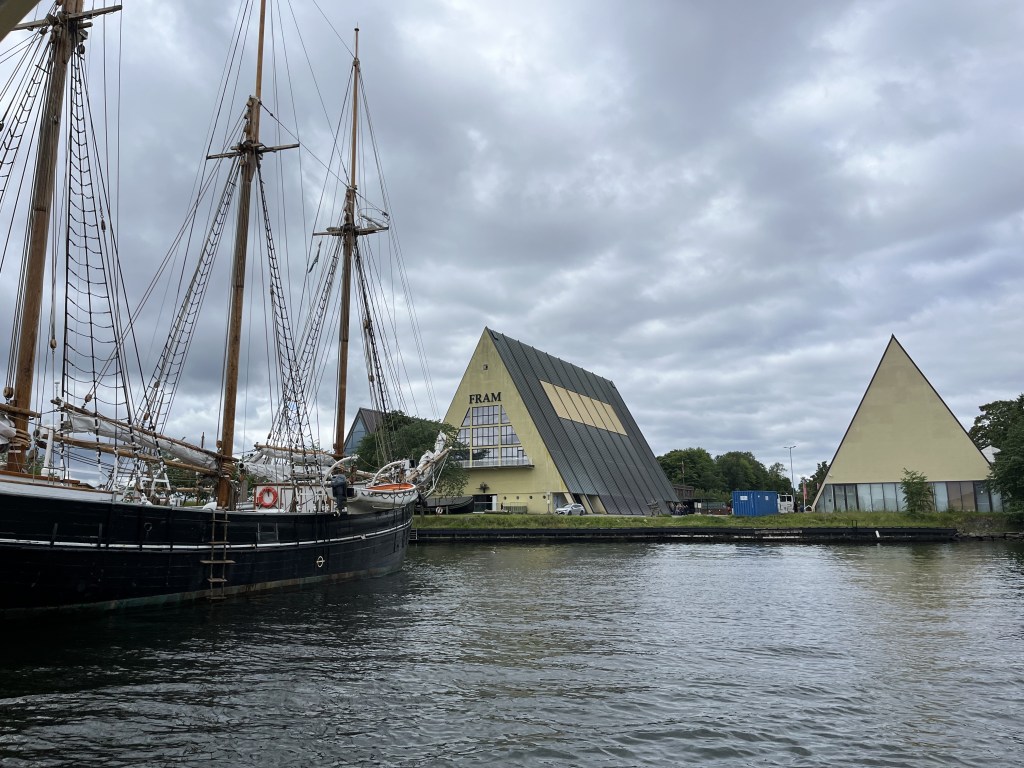
I’d seen pictures of it online, and was very curious what the internal layout was beneath the huge triangular frame, which I knew was built around the ship.
But I’m getting ahead of myself. The museums in Oslo are concentrated in an area called Bygdøy, a peninsula west of city centre. It’s accessible by ferry, which we took, though I later learned the bus8 is also an option. (It is, however, much less dramatic arriving by bus than gliding over the water).
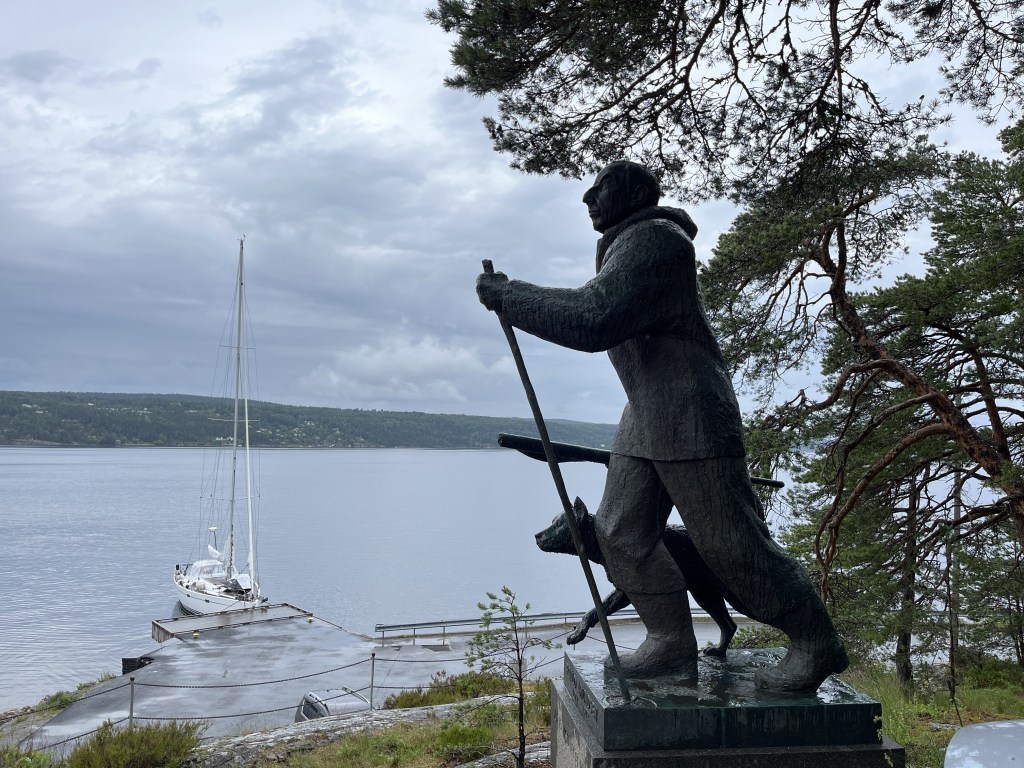
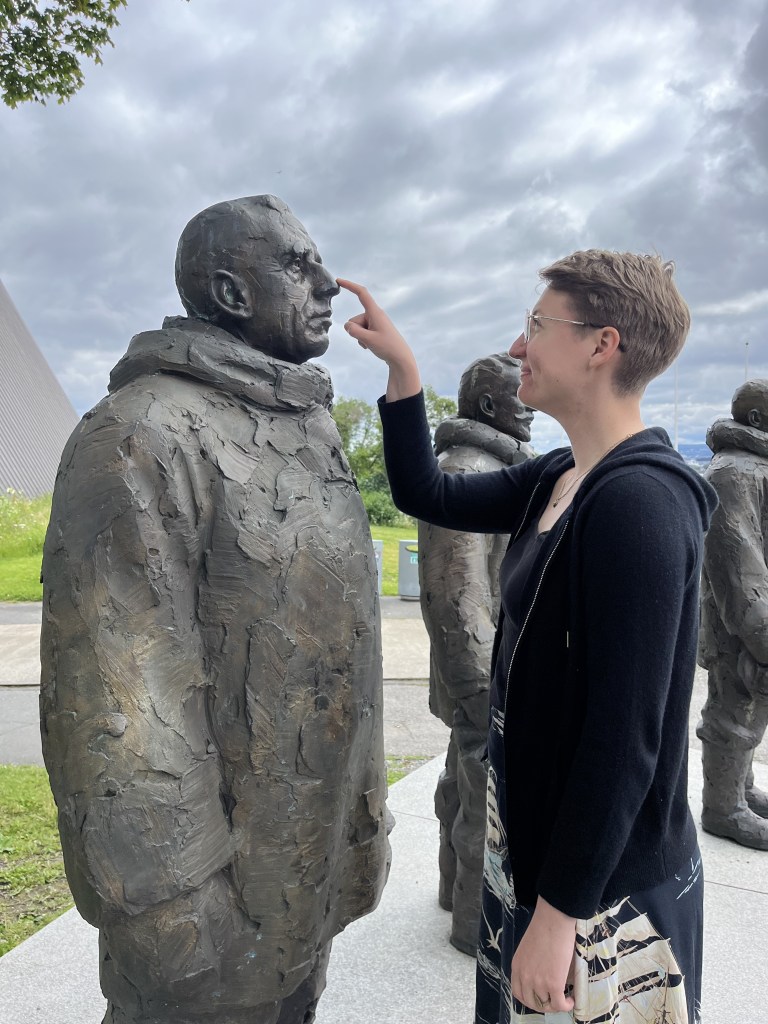
Before entering the museum proper, we went and found the statue of Amundsen and his polar party. It’s based on the iconic photograph at the south pole taken by Bjaaland, except Bjaaland is included in the statue rather than stuck behind the camera. The men stand facing south across the Oslofjord, towards the veeeeery distant pole.

We stepped into the museum to a cacophany of noise—the violent crashing of a storm at sea. This was part of a recording that plays on loop as videos of ice and ocean are projected on the ceiling. Viewed from the deck of the Fram, you can imagine you are sailing. Honestly, the storm was loud enough that I was concerned it might be overwhelming while going through the rest of the museum, but luckily it turned out we walked in at the loudest part, which only repeated every twenty minutes or so. The rest of the recording is calmer.
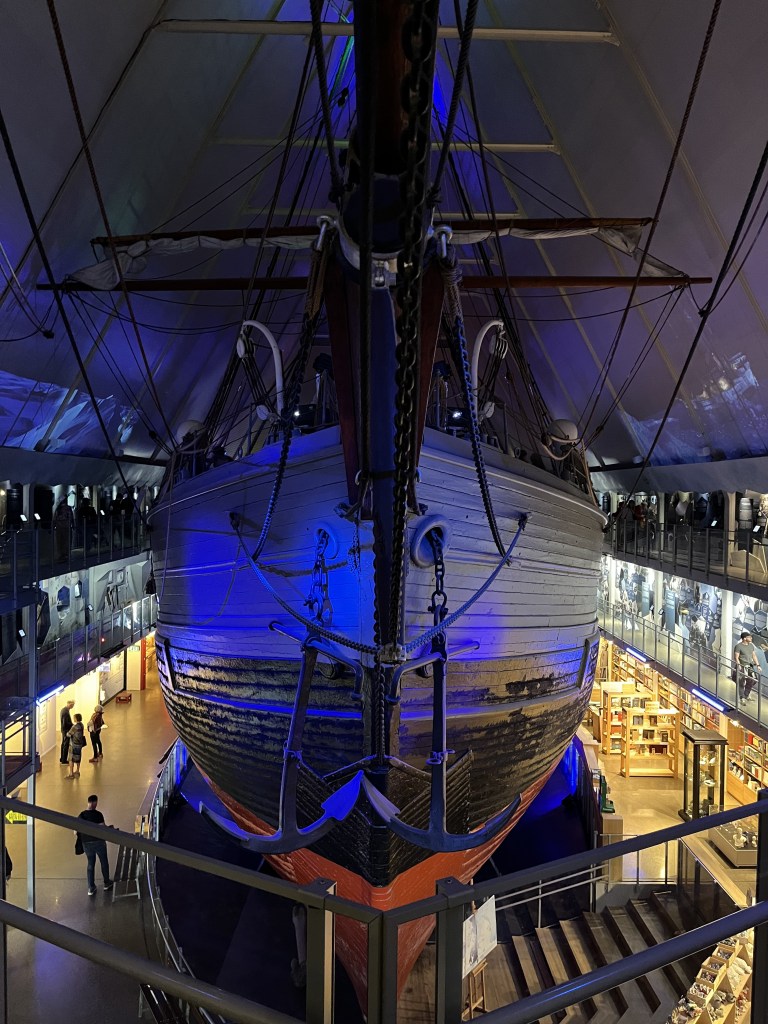
This was good because the main part of the Fram Museum is essentially one room—the ship herself is the grand centrepiece and everything else spirals up around her. The ground floor is home to the cafe and gift shop, and the exhibit snakes around two levels of balconies leading up to the ship. A tunnel leads out of the main triangular building to another one next door which houses the smaller Gjøa, of Northwest Passage fame. The Gjøa room has significantly more free space and is quieter.
Reader, we were like kids in a candy shop. There was so much to do and see! We spent all day at the Fram Museum, and I came back by myself two days later to take it all in again while Madeline was in the archives (they had a great student discount, okay?). I’ll take you through some highlights:
Café Framheim: They serve your Norwegian basics, like smoked salmon, waffles with brunost, etcetera. The food is good, but what makes it really special are the “booths”, made of wood and decorated with photos from various expeditions. They’re designed to evoke pre-fab polar expedition huts, and they succeed at creating a homey and private atmosphere even inside a museum that is, again, basically one big room. Naturally, we sat in the Maud hut.

(As an aside, I really loved waffles with brunost, which are a very common snack in Norway. Brunost is brown cheese, which is oddly creamy and definitely not everyone’s cup of tea. Madeline did not like it. Also inside the waffle is Norwegian sour cream, which is not quite like the stuff you get with Mexican food—the Norwegian stuff is light on the sour, heavy on the cream.)
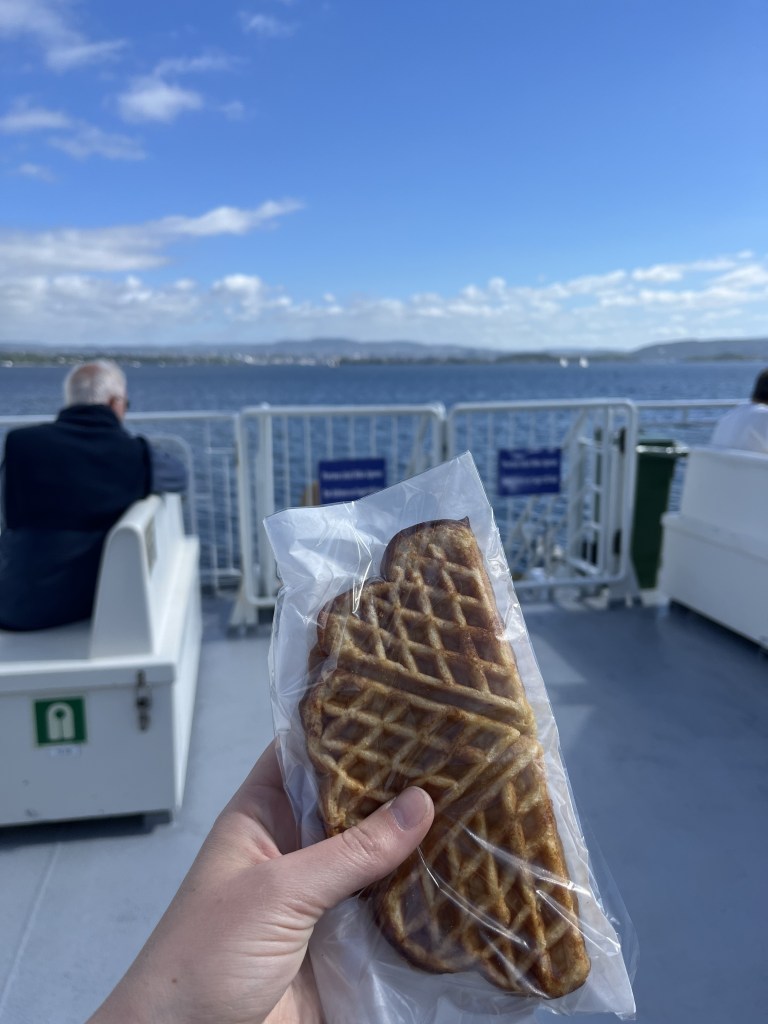
The exhibit proper: Had a wealth of information, biographies of all expedition members of all of Nansen and Amundsen’s expeditions, and some fun videos with museum staff re-enacting famous photos like the one where the crew at Framheim are sat around the table wearing goggles. I also really enjoyed the special exhibit on Nansen’s art and photography.

The Fram: I, of course, was chomping at the bit to see the ship. Like at Discovery, the ship itself features less interpretation (that is, explanatory museum text) in favour of having the visitor prepare for the ship by seeing the exhibit first. This works to make the ship both more immersive, and a main event of sorts, with the exhibit being the appetizer. By the time we got up on deck, we needed a break, so we sat on a clever moving bench near the bow and watched an entire cycle of the projection show. Especially combined with the bench, the illusion really did trick my brain! I felt a bit seasick when I stood up at the end of it. It was amazing.
Exploring the deck, I was tickled to find that, like at Discovery, most visitors take their pictures facing the wrong way at the helm—they stand in front of it and look astern. Here I am facing forward:

Belowdecks we found the men’s cabins, the stores, the galley—and realistic mannequins of Nansen and Lindström. Tables were set for Christmas dinner in one area; in another lounge an audio track played to match a diary entry one could read of an incident involving a polar bear. Dogs barked and panicked men shouted “Isbjørn! Isbjørn!”. The ship was very well-presented, and a visit is made more poignant by knowing that Wisting, Amundsen’s loyal comrade, died onboard her in 1936, in his own cabin. He was a major force in the creation of the Fram Museum.
The Gjøa: This little fishing ship had a mighty adventure, and it was an honour to get to step aboard—we hadn’t actually expected we could go inside Gjøa, so this was an added treat that it seemed a lot of visitors miss.

The man-hauling simulator: Look, I’m a sucker for interactive museum experiences, alright? Oddly, though the Norwegians are known for not man-hauling, the Fram Museum has a man-hauling simulator. A sign warns you that you participate at your own risk, and you just strap the belt to yourself and pull against some resistance while a meter tells you how much you’re hauling. There’s a kids’ one that goes up to 150kgs, and an adult one that goes up to 300kgs, though I’m a bit skeptical of those numbers because I was able to pretty easily do the adult one after a few tries flailing around to get the technique right. I was seriously addicted to this thing. I want one for a home gym.

The gift shop: Last but not least! Who doesn’t love a museum gift shop? I’d browsed the online store for the Fram Museum before, so I was expecting it to be horrendously expensive. However, it turns out a lot of the online cost is due to shipping and if one is physically present in Oslo the prices are much more reasonable. I have no qualms in saying the Fram Museum has the best gift shop of any polar museum I’ve been to,9 and I walked away with a correspondingly large haul. There was a very wide selection of books, including many in English. I bought a book about the Southern Cross expedition just because it was 20 krone (£1.43!).
While browsing the books, I saw a spine that stopped me dead in my tracks. Bear with me, reader: it was a young adult fiction book called Surviving Antarctica: Reality TV 2083. And…I recognised it. I grew up with a copy on my bookshelf, selected by me as a kid at a Scholastic book fair or something. The thing is? I never read it. I distinctly remember reading the first chapter or two when I was maybe 12, and stopping for some reason. It has sat on a bookshelf in the house I grew up in ever since.
Startled to see it at the Fram Museum gift shop, of all places, I slid it open and read the description:
It’s 50 degrees below zero.
The wind and snow blow so hard, you can’t see your hand in front of your face. Your heating fuel is nearly gone, and so is your food. How do you survive?Five fourteen–year–olds face this desperate situation on a deadly journey in Antarctica. It is 2083. They are contestants on a reality TV show, Antarctic Survivor, which is set up to re–create Robert F. Scott’s 1912 doomed attempt to be the first to reach the South Pole.
But in 2083 reality TV is not just an act. Contestants literally relive – or die during – the simulations of events. Robert Scott and his team were experienced explorers and scientists, but their attempt to reach the Pole proved fatal. What chance does the Antarctic Survivor team have?
This action–packed, riveting adventure – full of fascinating direct quotes from Scott’s journals and other accounts of the expedition – is both a heart–wrenching drama from the past and a disquieting glimpse into the future.
–from the inside flap of the cover of Surviving Antarctica: Reality TV 2083 by White
Oh. My. God. I fumed. It’s cheesy, I know, but if I had read that when I was 12, I would have gotten into polar history so much sooner! Alas, stood there in the Fram Museum gift shop, I pondered the little butterfly effects that make us find our interests when we do.
I did not buy the book, but I got the Kindle version the next day and read it quickly. I have mixed feelings to report that it would have gotten me obsessed, had I only read it when I was 12.

I also got a Fram t-shirt (which did feel a little bit like cheating on Discovery…but fear not, I know where my true love lies.) The gift shop had these great uncanny-valley edits of polar explorers with their faces on modern model bodies to advertise the t-shirts. This sense of humour is typical of the Fram Museum—whoever does the photo and video edits on their socials is truly killing it!

Finally, I could not resist getting a Little Roald, from Titina, an excellent film about Amundsen’s later aeronautical escapades with Umberto Nobile.
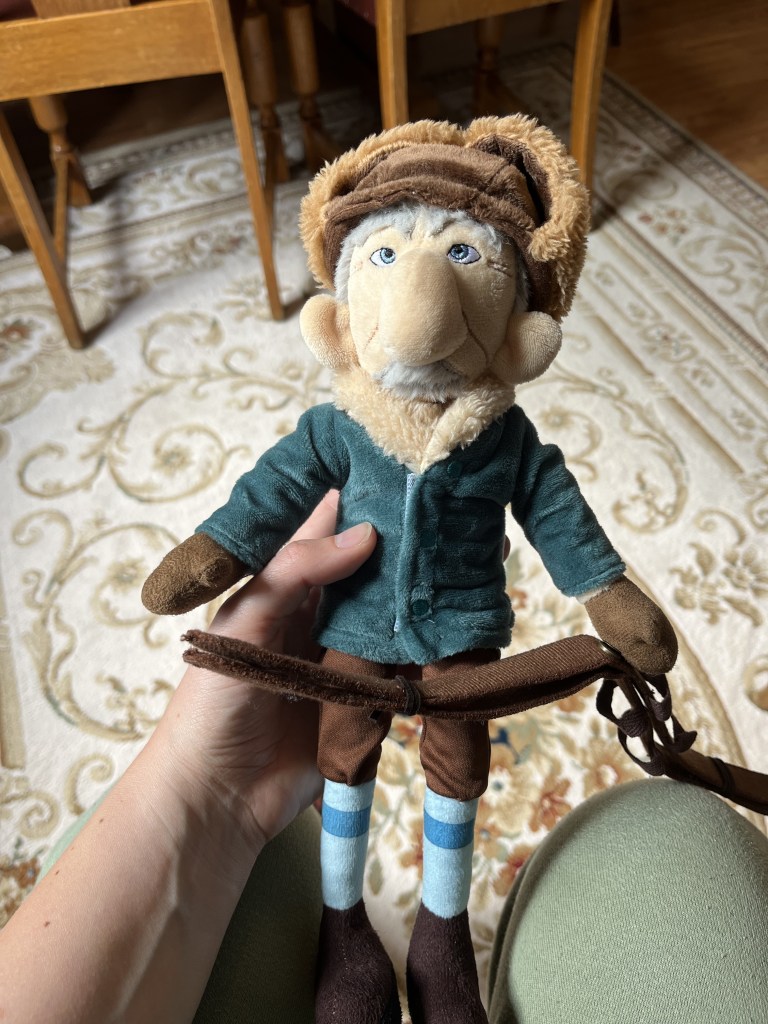
And there you have it, my polar travels in Norway. It was wonderful to experience the place that shaped a person like Amundsen, and getting to explore the Fram made my boat nerd heart sing. I’ll always remember the long evenings on the fjord, staring wistfully across the water at the ghosts of the past.
- The Uruguay, which went to Antarctica to rescue a Swedish expedition in 1903, still survives, but was not a main expedition vessel, nor was it constructed for Antarctic service the way Discovery and Fram were. The lifeboat James Caird is also still around, but again, not a main expedition ship ↩︎
- There is also a polar museum up in Tromsø, but this was too far for our budgets. I’ve heard great things, though! ↩︎
- Not to mention cities are expensive ↩︎
- Not geologically a fjord. The name is also used more broadly for other bodies of water ↩︎
- Of course, I did not experience it in winter ↩︎
- Impressive, but not the most impressive bus driving I’ve ever seen. That superlative goes to a driver on La Palma, in the Canary Islands, who reversed our tour bus through a switchback at something like 3000 metres elevation by the Roque de los Muchachos observatory. ↩︎
- Oddly, the booties were one-size, and did not fit over my hiking boots. The hiking boots are my bulkiest shoes, but still, I don’t have very large feet! What do people larger than UK 7 do?? I was told I could walk around in sock feet instead. I will forever treasure my pair of socks that are now contaminated with fibres from Amundsen’s carpet ↩︎
- I took the bus the second time because it was covered in my 7-day pass, while the museum ferry was a separate fee ↩︎
- That’s the Discovery, obviously, as well as the Polar Museum in Cambridge. Both have lovely gift shops but do need to expand their selection in my opinion! ↩︎


Leave a Reply